

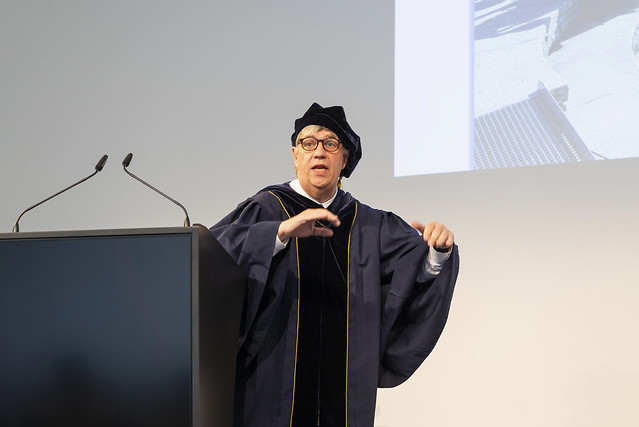
By Prof. Dr. Bert Wolfs, SBS Swiss Business School.
In executive education classrooms, one concern is increasingly common: What is the future of middle management in an era of AI, flatter organizations, and continuous restructuring?
The answer is not that middle management is disappearing, but that it is being fundamentally redefined.
For decades, middle managers were expected to manage complexity: coordinate across units, transmit decisions downward, consolidate reports upward, and ensure procedural compliance. That model was effective in stable, hierarchical organizations. Today, it is increasingly misaligned with how value is created.
Digitalization, automation, and AI have dramatically reduced the need for coordination-heavy roles. Information flows faster, decisions are increasingly data-driven, and many administrative tasks can be automated. As a result, organizations are questioning layers that add complexity without a clear impact.
What executives now expect from middle managers is value creation.
High-performing middle managers act as strategic integrators. They translate strategy into execution, prioritize scarce resources, and make judgment calls where algorithms cannot. Their relevance is measured not by span of control or reporting volume, but by outcomes: performance improvement, execution speed, risk reduction, and talent development.
Three capabilities distinguish the future-ready middle manager.
First, outcome ownership. Effective managers take responsibility for results, not just processes. They understand how their unit contributes to organizational value and can articulate that contribution in financial, operational, or strategic terms.
Second, digital and AI fluency. This does not require technical depth, but strategic literacy. Future-ready managers know how to leverage data, automation, and AI to improve decisions, redesign workflows, and challenge legacy practices.
Third, boundary-spanning leadership. As organizations flatten, influence matters more than authority. Middle managers who connect functions, align stakeholders, and resolve trade-offs become indispensable—because these capabilities cannot be easily automated.
For executive education participants, the implication is clear. The question is no longer how to manage complexity, but how to reduce it while increasing value. Middle managers who embrace this shift will remain central to organizational performance. Those who do not risk being optimized out of relevance.
In the future, middle management will not be about control: it will be about contribution.